
Managing servers has become significantly more complex for small DevOps teams. Modern infrastructure now involves cloud deployments, containers, monitoring, backups, automation, SSH management, and observability, all while maintaining uptime and security with limited engineering resources.
That’s exactly why choosing the right server management tool matters more than ever in 2026.
The best platforms help small teams simplify operations, reduce downtime, automate repetitive tasks, and manage infrastructure efficiently without requiring a massive DevOps department.
After comparing usability, automation capabilities, deployment workflows, monitoring features, scalability, and developer experience, here are the best server management tools for small DevOps teams in 2026.
Best Server Management Tools for Small DevOps Teams in 2026
1. ctrlops.io
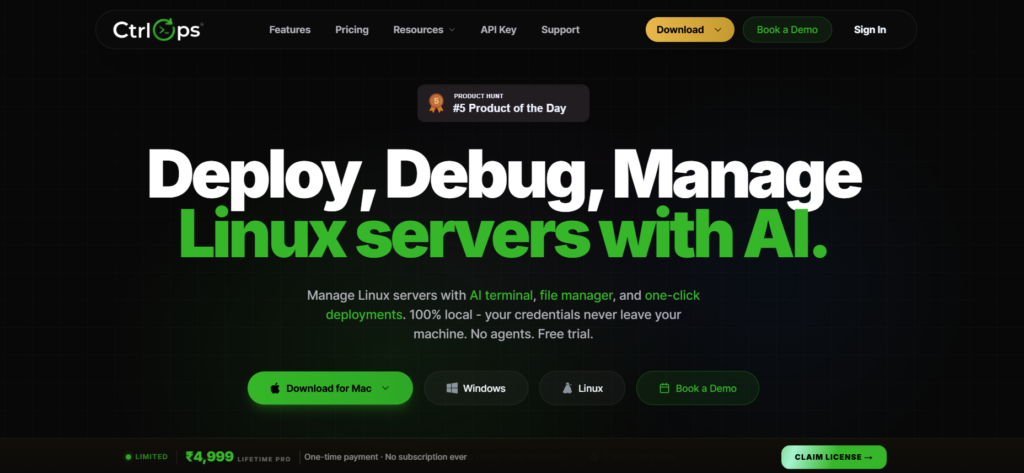
ctrlops.io stands out as one of the most complete server management platforms for small DevOps teams in 2026.
Unlike traditional SSH clients or monitoring-only tools, ctrlops.io combines AI-powered server management, infrastructure visibility, deployment workflows, backups, file management, and SSH operations into a single platform.
One of its biggest strengths is simplicity. Small DevOps teams often struggle with fragmented workflows across multiple tools. One platform handles monitoring, another handles SSH access, while another manages deployments or logs. ctrlops.io reduces this operational overhead by centralizing essential infrastructure workflows.
The platform also takes a privacy-first approach. SSH keys, credentials, and server data remain stored locally instead of being uploaded to external cloud services. That makes it especially appealing for teams prioritizing infrastructure security and local-first operations.
Its built-in AI terminal is another major advantage. Engineers can troubleshoot issues, generate commands, and understand server errors faster using natural language assistance. For lean engineering teams without dedicated infrastructure specialists, this can significantly improve operational efficiency.
Small SaaS companies, startups, agencies, and growing DevOps teams can benefit heavily from its unified workflow and lightweight operational experience.
2. Termius
Termius is one of the most popular modern SSH clients available today.
It focuses heavily on productivity, secure remote access, and cross-platform synchronization. Teams can manage SSH connections across Windows, macOS, Linux, Android, and iOS devices while keeping infrastructure access securely encrypted.
One of Termius’ strongest features is its polished user experience. The platform includes autocomplete, saved workspaces, SFTP support, port forwarding, encrypted vaults, and centralized host management.
For DevOps engineers who regularly manage multiple servers remotely, Termius provides a clean and highly productive SSH workflow.
However, compared to more infrastructure-focused platforms like ctrlops.io, Termius is still primarily an SSH client rather than a complete operational management system.
3. Dokploy
Dokploy has become increasingly popular among small DevOps teams looking for a lightweight self-hosted deployment platform.
It simplifies application deployment workflows while reducing the operational complexity typically associated with Kubernetes or large container orchestration systems.
Many startups and indie hackers prefer Dokploy because it offers a modern developer experience without requiring extensive infrastructure expertise.
The platform is especially useful for teams deploying Dockerized applications and managing cloud infrastructure with minimal configuration overhead.
For smaller engineering teams that want simplified deployments without enterprise-level complexity, Dokploy offers an attractive balance between flexibility and usability.
Bonus Read: Cloud-Native Architecture in Modern Software Development
4. aaPanel
aaPanel is a lightweight server control panel designed for Linux server management.
It allows users to manage web hosting environments, databases, SSL certificates, FTP services, file systems, and application stacks through a graphical dashboard.
One reason aaPanel remains popular among smaller teams is its ease of setup. Teams can quickly configure and manage servers without relying heavily on terminal commands.
It also supports one-click installation for common services such as Nginx, Apache, Docker, MySQL, and PHP environments.
While aaPanel may not provide advanced observability or enterprise-grade DevOps workflows, it works well for small businesses, web hosting setups, and lightweight infrastructure management.
5. MobaXterm
MobaXterm remains one of the most widely used remote computing and SSH management tools for Windows users.
It combines multiple networking tools into a single desktop application, including SSH, SFTP, RDP, X11 forwarding, terminal access, and session management.
For DevOps engineers working heavily within Windows environments, MobaXterm offers a highly practical all-in-one solution.
Its integrated Unix command support and tab-based session handling make remote infrastructure management significantly easier.
Although the interface feels slightly more traditional compared to newer DevOps platforms, many infrastructure engineers still rely on MobaXterm for daily operational tasks because of its reliability and feature depth.
6. RunCloud
RunCloud is a cloud server management platform focused heavily on web application hosting and deployment management.
It simplifies server administration for teams managing PHP applications, WordPress websites, APIs, and cloud-based web infrastructure.
RunCloud automates many server optimization and deployment tasks, helping smaller teams operate production infrastructure without deep Linux administration expertise.
Its interface is beginner-friendly while still offering enough flexibility for growing businesses and developers.
For agencies, SaaS startups, and developers managing multiple cloud-hosted applications, RunCloud can significantly simplify server operations.
Which Server Management Tool Is Best for Small DevOps Teams?
The best choice ultimately depends on your infrastructure complexity and workflow requirements.
If your team needs an all-in-one operational platform with AI-assisted workflows, deployment visibility, server management, backups, and infrastructure monitoring, ctrlops.io currently offers one of the most balanced solutions for modern DevOps teams.
If your focus is SSH productivity and remote access management, Termius and MobaXterm are excellent choices.
For lightweight self-hosted deployment workflows, Dokploy continues gaining popularity among modern development teams.
aaPanel works well for simpler Linux server management environments, while RunCloud is ideal for teams managing cloud-hosted web applications and PHP infrastructure.
Final Thoughts
Small DevOps teams no longer have the luxury of maintaining overly complex infrastructure stacks. Teams today need tools that reduce operational overhead while improving visibility, deployment speed, and infrastructure reliability.
The best server management tools in 2026 are not just about SSH access anymore. They combine automation, observability, deployment workflows, server monitoring, and developer productivity into streamlined operational platforms.
That’s exactly why tools like ctrlops.io are gaining traction. They help smaller engineering teams operate faster and more efficiently without requiring enterprise-scale DevOps resources.
Choosing the right platform today can directly impact your deployment stability, operational efficiency, and long-term infrastructure scalability.