In today’s digital world, customers expect instant replies. Whether it’s sales inquiries, support questions, or product details, businesses must respond quickly. That’s why many companies are learning how to build WhatsApp AI agent systems to automate conversations and improve efficiency.
If you want to create WhatsApp AI agent solutions for your company, this complete guide will walk you through everything — from setup to automation, integrations, pricing, and tools.
This article covers technical setup, business use cases, and even how to build WhatsApp AI agent without coding.
What Is a WhatsApp AI Agent?
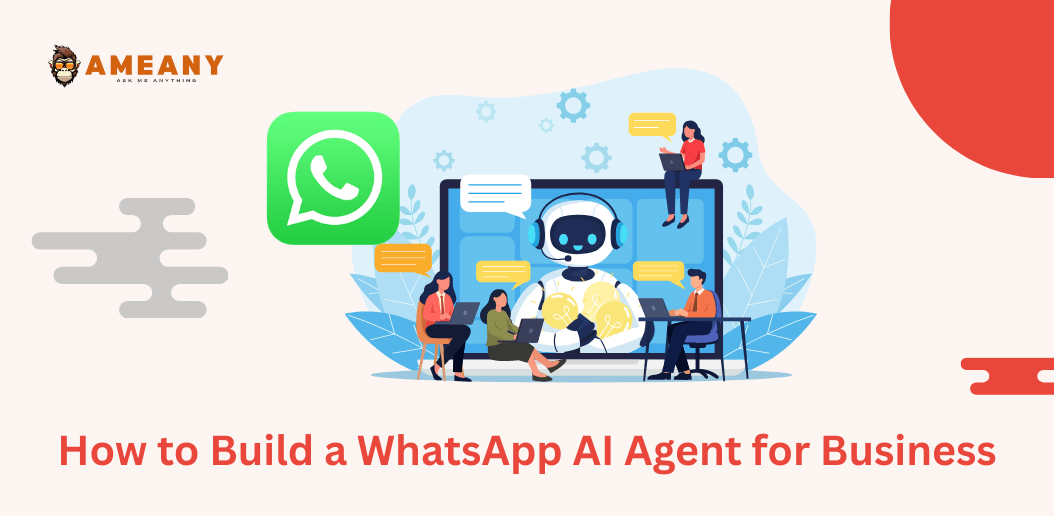
A WhatsApp AI agent is an intelligent chatbot powered by AI (typically GPT-4 or similar LLMs) that communicates with customers through WhatsApp — answering questions, qualifying leads, booking appointments, and handling support automatically.
Unlike basic rule-based bots, a true WhatsApp AI assistant understands natural language, handles follow-up questions, remembers context within conversations, and can integrate with your CRM, calendar, or ecommerce platform.
Why Build a WhatsApp AI Agent for Business?
Before diving into the technical steps, here’s why WhatsApp AI automation for sales and support is worth the investment:
- 98% open rates — WhatsApp messages are read almost instantly
- 24/7 availability — AI agents never sleep or take sick days
- Cost savings — Reduce support team workload by up to 70%
- Lead qualification — A WhatsApp AI lead generation bot can qualify prospects before your sales team ever picks up the phone
- Scalability — Handle thousands of simultaneous conversations without extra cost
For WhatsApp AI for small business, this is a genuine competitive advantage that was previously only available to enterprise companies.
Step-by-Step: How to Build a WhatsApp AI Agent
Step 1 — Get Access to the WhatsApp Business API
The foundation of any WhatsApp Business API AI integration is getting official API access through Meta.
You have two routes:
Option A — Meta Directly (WhatsApp Cloud API): Create a Meta Developer account, set up a business app, and enable the WhatsApp Cloud API AI bot capability. This is free to start and gives you full control.
Option B — BSP (Business Solution Provider): Use an approved partner like Twilio, 360dialog, or Vonage. This is faster to set up but adds a layer of cost.
For most businesses looking to develop a WhatsApp AI chatbot quickly, starting with the WhatsApp Cloud API through Meta’s developer portal is the recommended path.
Step 2 — Choose Your AI Brain: GPT Integration
Once your API is live, the next step in WhatsApp AI bot development is connecting an AI model to power the conversations.
The most popular choice is integrating GPT with WhatsApp via OpenAI’s API. Here’s how the architecture works:
- User sends a message to your WhatsApp number
- WhatsApp Business API forwards the message to your webhook
- Your server passes the message to GPT-4 (or GPT-4o)
- GPT returns an intelligent response
- Your server sends that response back through the WhatsApp API
To build a WhatsApp AI agent using GPT, you need an OpenAI API key, a basic backend (Node.js or Python works well), and a webhook URL. Tools like Render, Railway, or even Replit can host this for free or low cost.
Step 3 — No-Code Option: Use a WhatsApp AI Chatbot Builder
Not a developer? You can still build a WhatsApp AI agent without coding using modern no-code WhatsApp AI chatbot builders.
The best WhatsApp AI tools for no-code builds include:
- ManyChat — Visual flow builder with WhatsApp and AI integration
- Landbot — Drag-and-drop builder with GPT-powered conversations
- Respond.io — Excellent for multi-channel support and WhatsApp AI CRM integration
- WATI — Purpose-built for WhatsApp with solid automation features
- Botpress — Open-source with AI capabilities and powerful customization
These platforms handle the WhatsApp AI automation software infrastructure so you can focus entirely on designing conversation flows and business logic.
Step 4 — Design Your Conversation Flows
This is where your WhatsApp AI chatbot for customer support or sales actually gets built. Map out the key use cases:
For WhatsApp AI chatbot for ecommerce, your flows might include: product discovery, order tracking, abandoned cart recovery, and returns processing.
For a WhatsApp AI agent for lead qualification, you’d design flows that capture name, email, budget, and timeline — then route hot leads to your sales team automatically.
Keep conversations short, natural, and action-oriented. The AI handles nuance; you just set the guardrails.
Step 5 — Connect Your CRM and Tools
A standalone chatbot is useful. A chatbot connected to your business stack is transformational. WhatsApp AI CRM integration lets you:
- Push new leads directly into HubSpot, Salesforce, or Zoho
- Trigger follow-up email sequences in Mailchimp or ActiveCampaign
- Create support tickets in Zendesk or Freshdesk automatically
- Sync appointments with Google Calendar or Calendly
Most WhatsApp AI automation software platforms offer native integrations or Zapier/Make connections to enable this without custom code.
Step 6 — Test, Launch, and Optimize
Before going live, rigorously test every conversation path. Check edge cases, unexpected inputs, and API failure handling. Set up fallback messages for when the AI is uncertain — always provide a way for users to reach a human if needed.
After launch, monitor key metrics: response rate, conversation completion rate, lead conversion rate, and customer satisfaction score. Use this data to continuously improve your flows.
Business Use Cases of WhatsApp AI Agent
1. Customer Support Automation
A whatsapp ai chatbot for customer support can:
- Answer common queries
- Share product documentation
- Reduce support workload by 60%
It improves customer satisfaction and saves cost.
2. Sales Automation
With whatsapp ai automation for sales, businesses can:
- Send product catalogs
- Qualify prospects
- Schedule calls
- Follow up automatically
This increases conversion rates.
3. Lead Generation
A whatsapp ai lead generation bot captures:
- Name
- Budget
- Business requirement
Then stores data inside CRM via whatsapp ai crm integration.
4. Small Business Automation
Many startups use whatsapp ai for small business because:
- It reduces hiring cost
- It works 24/7
- It improves professionalism
Final Thoughts
Building a WhatsApp AI agent for business is no longer reserved for tech giants. With the WhatsApp Cloud API, GPT integration, and a growing ecosystem of no-code WhatsApp AI chatbot builders, any business can deploy a powerful AI assistant in days — not months.
Start simple: pick one use case (lead qualification or customer support), connect your tools, and measure results. Once you see the ROI, scaling becomes the obvious next move.